Your AI is brilliant.
It just knows nothing about you.
Build the maintained knowledge base every AI tool you use works from — and stop re-explaining your business in every session.
The complete starter template + walkthrough. Free.
No code required · You own the system · 30-day guarantee
You already know this loop
The amnesia loop
Every session starts from zero. You re-upload the same documents, re-explain the same background, re-state the same preferences — five to ten minutes of setup before any real work begins. Every single time, in every tool.
The memory you can't control
Built-in AI memory decides what to keep, forgets what mattered, and you can't audit any of it. For real work, that's a dealbreaker.
The system that becomes the work
You've tried the notes app, the workspace, the elaborate setup. It fills up, rots, and three weeks later you're back to pasting context into a fresh chat.
Scattered AI, scattered results
ChatGPT knows one version of you, Claude another, your agents a third. Every tool is only as good as whatever you managed to paste in that day.
You're not imagining it — everyone doing real work with AI hits this wall:
“Sometimes takes 5–10 minutes just to get ChatGPT back up to speed on context it should already know.” — r/ChatGPTPromptGenius
“I end up constantly saving little notes, re-explaining context, or updating Projects just to keep continuity… it's mentally taxing and inefficient.” — r/ChatGPT
“And every time I do, I'm sitting there thinking ‘we literally already figured this out together.’” — r/ChatGPT
An archive is a cost.
A maintained system compounds.
Notes apps, custom GPTs, and built-in memory all fail the same way: they collect, but nothing maintains. The pile grows, trust decays, and you go back to the blank chat.
Compound Context flips it. You build one source-backed knowledge base about your work — and the AI acts as its maintainer, under a written job description, with you reviewing every change.
Small enough to trust. Maintained enough to compound. Read by every AI tool you use.
I built this for myself first.
It runs my work every day.
Every serious task started with ten minutes of archaeology: find the old chat, re-upload the docs, re-explain the client. I was the context. If I didn't type it in, the AI didn't know it — and by Thursday I was pasting the same background for the third time that week.
Now every tool I open already knows my business, my clients, and how I like to work. I start at the actual task, the answers cite my own documents, and the weekly review takes less time than one old context rebuild did.
The number that isn't here yet — on purpose:
Before doors open, I'm timing the same real task twice — once without the system, once through it — on camera, no editing tricks. That measured before/after will sit right here. Until it's real, this page shows no number: I'd rather leave the slot honest than fill it with an estimate.
What actually changed:
- No context rebuild — the AI already knew my business, clients, and preferences.
- Answers cite my own documents instead of inventing plausible-sounding facts.
- The output needed review, not reconstruction.
I'm a professional software engineer. I've been building and running these systems for my own work for 2 years. This course is that system, taught.
Honest note: this is a founding edition. There are no student testimonials yet — you'd be among the people who create them. That's exactly why the price is what it is (see below).
How Compound Context works
Sources go in once. Every tool works from the same maintained truth.
Five parts, built in order, on your real material:
- What goes in — source selection: what your AI needs to know, what to skip.
- Where it lives — a structure that stays navigable instead of becoming a pile.
- Who keeps it alive — the AI's written job description + your review gate.
- Where it's used — your actual tools, all reading from one source of truth.
- How it stays trustworthy — maintenance routines and quality checks, on a bounded schedule.
5 blocks, 16 lessons —
every lesson ends in a deliverable
You don't need to be technical. You need to show up with your real work. Where you are at each step:
- TodayYou paste context into a blank chat and hope. You are the memory.
- Lesson 1You’ve watched the same task come out visibly better — and you have the number to prove it.
- Block IYou know exactly what your AI needs to know about you — and what it never should.
- Block IIYou can write context that actually changes what your AI produces. The skill most people never get.
- Block IIIA working knowledge base exists. Your AI maintains it under your rules, every tool reads from it.
- Block IVWhen an answer is wrong you fix the system instead of re-explaining — and measure the improvement.
- Block VIt compounds on its own schedule — a bounded weekly review, ready for agents that act.
Design what your AI needs to know
- 1The one-page proof. Take one task you keep redoing. Do it cold and time it. Write one page. Do it again. Put the two side by side. You leave with: your context seed, your two-output diff, and your honest baseline — in your first sitting.
- 2Capture vs. skip. Pick a bounded, safe source set. Draw your privacy zones: private / internal / shareable. You leave with: your source list + your written privacy policy. Reviewed by me
- 3The context audit. Map what your AI needs to know about you: business, clients, projects, processes, preferences. You leave with: a context map of your own work.
- 4The loaded core vs. the library. Why a system that just keeps growing makes your answers worse — and what to keep loaded instead. You leave with: a structure that survives growth instead of becoming a pile.
Write context your AI actually uses
- 5Rules, not descriptions. “We're professional and friendly” is worth nothing. “We never propose a retainer first” changes every answer. Examples beat adjectives; the constraints you never write down are the ones that matter. You leave with: your context seed rewritten, vagueness removed.
- 6The outsider test, and the five ways this fails. The archive nobody reads. The over-engineered structure. The context so long the model stops paying attention. The silent bad write. The system that became the work. You leave with: your own draft diagnosed against every known failure mode.
- 7Your core pages, built for real. You leave with: context that measurably changes your AI's output. Reviewed by me — this is where feedback is worth the most
Build and connect the working system
- 8Three ingests by hand, then your AI's job description. Do it manually first, notice what you keep repeating — then turn that into rules: what it may read, what it may write, when it must stop and ask you. You leave with: agent instructions you earned, not a template you filled in.
- 9Wire in your tools. ChatGPT/Claude Projects reading from your knowledge base — no code, no installation. You leave with: your daily tools drawing from one source of truth.
- 10Real work, end to end. Decisions, deliverables, delegation — one real current task, start to finish. You leave with: a real piece of your work produced through the system.
Make it compound
- 11When the answer is wrong. Stop re-explaining and start diagnosing: what did the context fail to say? Patch it once and that whole class of error is gone permanently. You leave with: the loop you'll still be using in two years.
- 12Your eval set. Five tasks whose good answer you already know, re-runnable after every change. You leave with: proof it's improving — and permission to stop building. Reviewed by me
- 13The bounded routine and quality checks. Catch staleness, contradictions, and drift before they cost you trust. You leave with: upkeep on your calendar, sized to your real life — not a second job.
Beyond you
- 14From answering to acting. What changes when the AI does the work instead of describing it — your system as the briefing an agent runs on. You leave with: an agent-ready context system.
- 15Team. Shared truth, permissions, and what happens when someone else edits. You leave with: a team extension plan — or a clear decision to stay solo.
- 16Day 30 / 60 / 90. The long game, and the honest close against the baseline you took in lesson 1. You leave with: your measured before/after — your own proof.
Want to try the system before the course opens?
Works with the tools you already have
Default path: ChatGPT or Claude Projects, with Notion, Obsidian or Google Drive as the store. No code, no installation. If you can upload files and manage folders, you have everything you need.
One tool is enough. The system is one portable source of truth; the tools plug into it. A power path (plain files + CLI agents) exists for the technical minority — strictly optional.
The system survives tool churn — that's the point. Your knowledge stays readable, inspectable, and movable, not locked inside one vendor's memory.
See it before you buy it
No stock screenshots, no mockups — this is the actual system and the actual material:
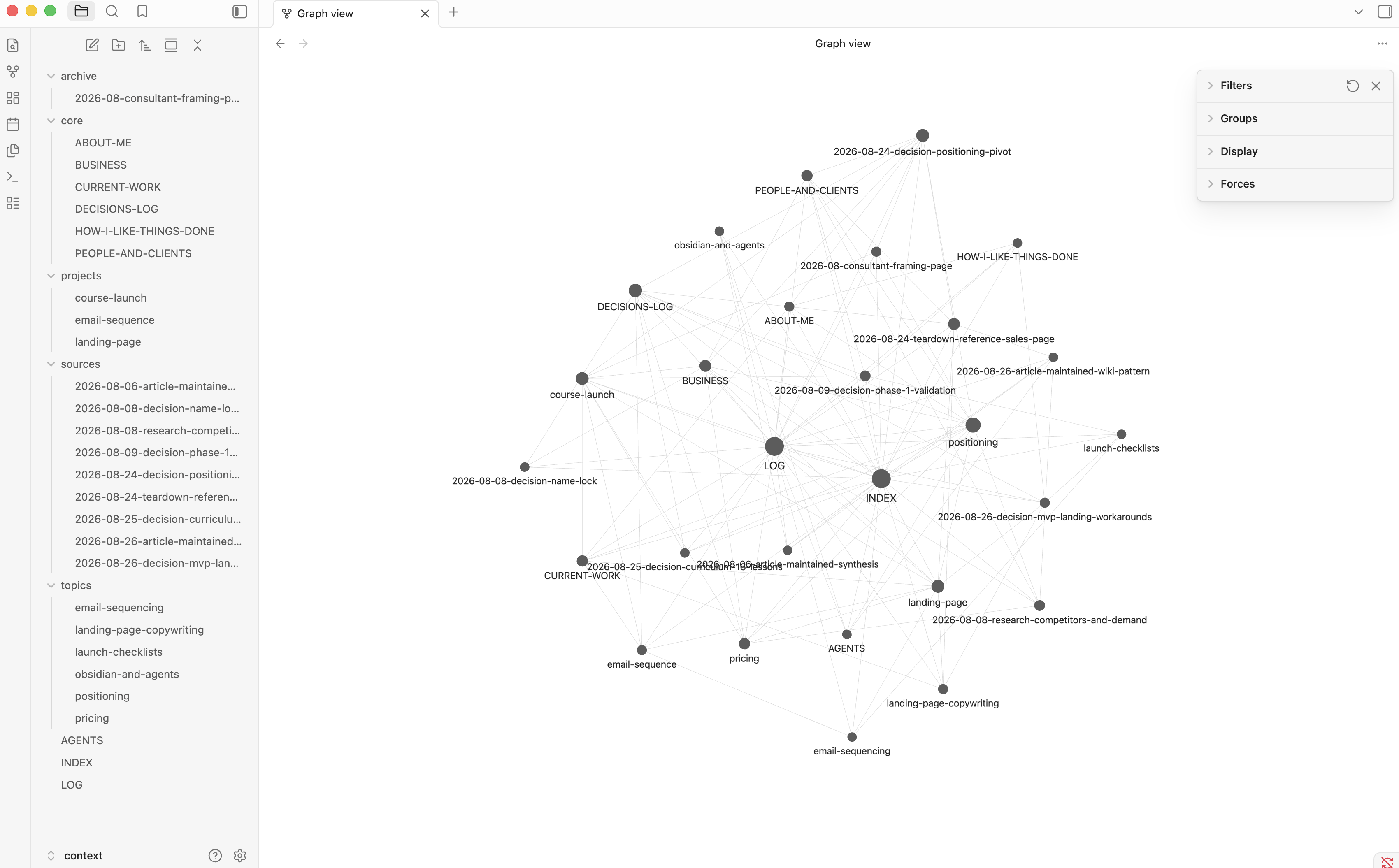 My real knowledge base
The structure you'll build, as it actually runs my work today.
My real knowledge base
The structure you'll build, as it actually runs my work today.
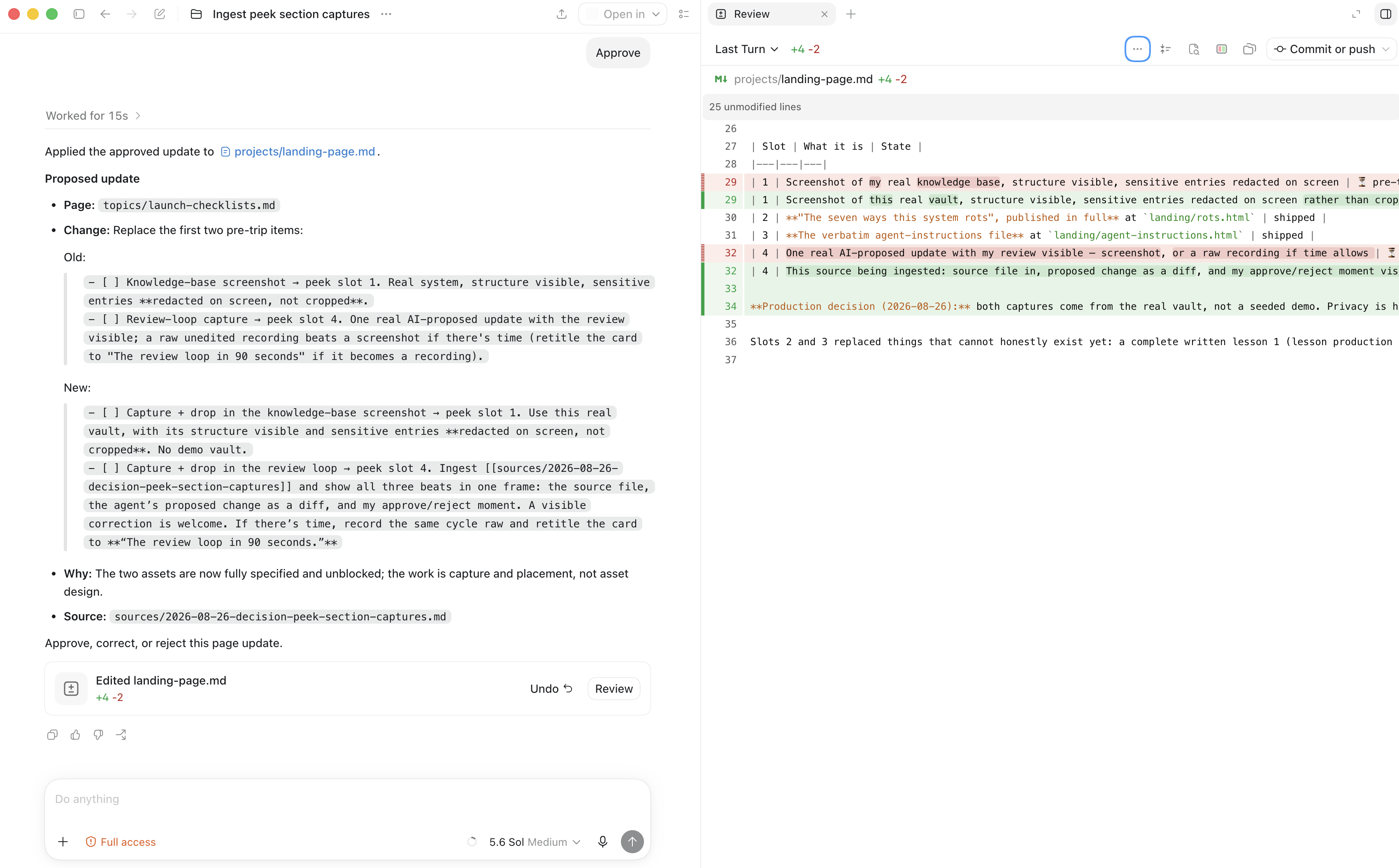 The review loop, caught live
One real document in, one AI-proposed update out, my approval visible. Straight from
my system, unedited.
Read it now — no email needed
A complete piece of the material, free →
“The seven ways this system rots” — the honest one-pager from the Starter Kit on how
builds like this usually die. If this writing doesn't earn your trust, the course won't either.
Read it now — verbatim, unredacted
The AI's actual job description →
The exact agent-instructions file my maintainer runs under: what it may read, what it
must cite, what it proposes, and what it never touches without me.
The review loop, caught live
One real document in, one AI-proposed update out, my approval visible. Straight from
my system, unedited.
Read it now — no email needed
A complete piece of the material, free →
“The seven ways this system rots” — the honest one-pager from the Starter Kit on how
builds like this usually die. If this writing doesn't earn your trust, the course won't either.
Read it now — verbatim, unredacted
The AI's actual job description →
The exact agent-instructions file my maintainer runs under: what it may read, what it
must cite, what it proposes, and what it never touches without me.
If what you see here doesn't look like something you'd use every week, keep your money — the Starter Kit below is free.
Everything you get
- All video + written lessons, Blocks I–V — 16 lessons (IV–V as released)
- The optional add-on tracks: power track (files + CLI agents), tool walkthroughs, troubleshooting
- Homework with personal feedback (response within 24 hours)
- The complete template library: structure, agent-instruction files, checklists, maintenance routines
- The Starter Kit, fully included and extended
- Private community (Discord)
- Every future update and extension of this edition
- 30-day unconditional money-back guarantee
“But I already use AI every day.”
Exactly. That's who this is for. Three things people say right before this clicks:
“ChatGPT already has memory. I already use Projects.”
Built-in memory decides for itself what to keep, forgets what mattered, and can't be audited — and it lives inside one vendor's product. A Project holds files; nothing maintains them. What you're missing isn't storage — it's one maintained, inspectable source of truth that every tool reads and that gets better every week instead of staler.
“I'm not technical.”
If you can use ChatGPT, upload files, and manage folders, you're technical enough. The default track has no code and no installation. The technical path exists — and it is strictly optional.
“I've built systems before. They rot.”
So did mine — every archive rots, because collecting isn't maintaining. This course is mostly about the part everyone skips: the AI does the maintenance work under a written job description, you review on a bounded weekly schedule, and quality checks catch drift before it costs you trust. Block IV exists precisely because of this objection.
Is this for you?
For you if:
- You use ChatGPT or Claude (or AI agents) every day for real work.
- You're tired of re-explaining your business, projects, and preferences in every session.
- You'll spend 2–3 hours a week building on your own real material.
- You want a system you own and can inspect — not another opaque tool.
Not for you if:
- You want memory that manages itself with zero review. (Be suspicious of anyone selling that.)
- You're looking for RAG, embeddings, or tool-comparison tutorials — we deliberately don't go there.
- You collect notes for their own sake. This course measures whether your work got better, not how many pages you have.
I'd rather talk you out of a bad fit now than refund you later.
Who's behind this

I'm Nikolas Barwicki, an AI product engineer. I've worked with LLMs every day since ChatGPT 3.5 launched — and somewhere in those years I got tired of re-explaining myself to a tool that forgot everything by the next chat. So I built the system this course teaches: one maintained, source-backed knowledge base my AI tools read from. The system in the proof section is that system — my own work runs on it today.
Compound Context @compoundcontext ↗Founding edition pricing
$149
One price, everything listed above.
- That's under $15 per lesson — each one ending in a deliverable built on your own business, with personal feedback.
- Invoice provided at purchase. This is a business expense: you're buying back the hours you currently spend re-explaining your business to a tool that forgot it yesterday.
- The next edition will be $299+. That's a real future price, not launch theater: founding members pay less because you're helping me validate the curriculum — I'll ask you for blunt feedback and, if the results earn it, a testimonial.
- 30 days, money back, no conditions. Join, do Block I, and if it's not working for you, one email gets a full refund.
Doors open November 2026.
List members hear first and get the founding price.
Questions you should be asking
Can't I build this myself for free?
Will the AI maintain everything automatically?
How technical do I need to be?
Which tools does it work with?
What about confidential data?
How much time does it take?
Am I locked in once I build it?
Not ready? Start free.
The Compound Context Starter Kit: the structure template, a ready-to-paste AI job-description file, the capture-or-skip checklist, and a walkthrough that gets one document in and one reviewed update out — today.
Plus the one-pager to read before week three: “The seven ways this system rots” — the honest list of how builds like the one you’re about to do usually die. If you never buy anything, read that one anyway.
No purchase required. Kit subscribers hear first when the founding edition opens.
Stop being your AI's memory
Compound Context — the founding edition. Build the maintained knowledge base every AI tool you use works from, on your own real material, with feedback, in six weeks. $149, 30-day unconditional guarantee.
Doors open November 2026.
P.S. Every week without the system is another week of explaining your business to a tool that forgot it yesterday — five to ten minutes of setup, several times a day, in every tool you use. That's the real price, and you're already paying it.